
Hemp-derived CBD products contain cannabidiol extracted from industrial hemp plants, and despite their legal status in Canada’s consumer market, they fall squarely under Transport Canada’s cannabis restrictions for aviation personnel. Whether purchased from a hemp brand or a licensed retailer, these products are treated identically to marijuana-derived cannabis under Canadian aviation safety rules.
This creates a significant compliance challenge for flight crew, air traffic controllers, and flight service specialists. While Canadians can legally purchase CBD oils, capsules, and topicals, aviation professionals holding Transport Canada Medical Certificates face an absolute 28-day prohibition before reporting for duty. The regulation makes no distinction based on THC content, product formulation, or marketing claims about non-intoxicating properties.
The confusion stems from cannabis legalization in 2018, which opened retail markets for hemp-derived wellness products while leaving aviation safety standards firmly in place. Transport Canada’s fitness-for-duty requirements under the Canadian Aviation Regulations prohibit crew members and controllers from using any substance that could impair their faculties, and the department’s 2019 policy explicitly extended this to all cannabis products, including those derived from hemp.
This article clarifies how Transport Canada categorizes hemp-derived CBD, explains the 28-day rule and its enforcement, addresses cross-border travel restrictions that catch even compliant professionals off guard, and provides practical guidance for aviation employees navigating prescription exemptions and employer policies. Understanding these regulations is essential for maintaining both career credentials and aviation safety standards in 2026.
What Hemp-Derived CBD Means Under Canadian Law
Under Canadian law, hemp-derived CBD occupies a clear but often misunderstood position: it remains cannabis, regardless of its source. The Cannabis Act, which governs all cannabis products in the country, makes no distinction between CBD extracted from industrial hemp and CBD derived from marijuana plants. Both are regulated cannabis products subject to the same federal oversight, licensing requirements, and use restrictions.
The confusion stems from the plant source. Industrial hemp and marijuana are both varieties of Cannabis sativa, but hemp is cultivated for fibre, seeds, and non-intoxicating compounds, while marijuana is bred for higher concentrations of THC (tetrahydrocannabinol), the primary psychoactive cannabinoid. Hemp-derived CBD products typically contain little to no THC, leading many consumers to believe these products fall outside cannabis regulations. They do not. Health Canada and Transport Canada treat all CBD products as cannabis, full stop.
- Hemp-derived cannabis
- Cannabis products extracted from industrial hemp plants (Cannabis sativa varieties bred for low THC content). Despite the hemp source, these products are regulated as cannabis under federal law.
- CBD (cannabidiol)
- A non-intoxicating cannabinoid found in cannabis plants that is marketed for various wellness purposes. CBD products remain controlled substances under the Cannabis Act regardless of THC content or plant variety.
- Hemp vs. marijuana
- Both are Cannabis sativa, differentiated primarily by THC concentration. Hemp contains minimal THC; marijuana is bred for higher levels. Canadian law regulates CBD from either source identically.
- Cannabis extracts
- Concentrated forms of cannabis, including oils, tinctures, and isolates, extracted through mechanical or chemical processes. Hemp-derived CBD oils and isolates fall into this category.
- Cannabis topicals
- Cannabis-infused products applied to skin, such as creams, balms, and lotions. Even non-intoxicating topicals containing hemp-derived CBD are regulated cannabis products in Canada.
The legal status is straightforward: Health Canada licenses all CBD products sold legally in Canada through the cannabis framework. Whether derived from hemp or marijuana, whether containing THC or not, CBD products are cannabis products. For aviation professionals, this regulatory classification carries significant weight. The fitness-for-duty requirements in the Canadian Aviation Regulations apply to all cannabis use, making hemp-derived CBD subject to the same prohibitions as any other cannabis product. The product label may say “hemp” or “non-psychoactive,” but Transport Canada views it as cannabis, with all associated restrictions.
How Canadian Aviation Regulations Apply to CBD Products

The 28-Day Prohibition for Flight Crew and Controllers
On June 3, 2019, Transport Canada established a mandatory 28-day cannabis abstinence period for flight crew and air traffic controllers before reporting for duty. This policy creates a clear separation between cannabis consumption and aviation responsibilities, regardless of whether the product is derived from industrial hemp or contains only CBD.
The prohibition applies to crew and controllers who hold Transport Canada Medical Certificates for their aviation permits, licenses, or ratings. That means pilots, air traffic controllers, and flight service specialists must avoid all cannabis products, including hemp-derived CBD oils, edibles, topicals, and extracts, for at least 28 days before they’re scheduled to work.
Transport Canada selected this timeframe based on how long cannabis compounds can remain detectable in the body and potentially affect cognitive function, reaction time, and decision-making. The policy doesn’t distinguish between THC-dominant products and CBD-dominant ones; any hemp-derived CBD product falls under the same 28-day rule because it still qualifies as a cannabis product under Canadian law.
Aviation personnel who consume CBD products between duty periods assume the risk that residual cannabinoids could be present during flight operations. The 28-day window provides a buffer that accounts for individual metabolic variation and eliminates ambiguity about when it’s safe to resume safety-sensitive duties after consuming any cannabis-derived substance.
Employer Authority to Impose Stricter Rules
Transport Canada’s 28-day prohibition establishes a regulatory floor, not a ceiling. Air operators retain full authority to implement stricter cannabis policies for their workforce, and many do. This means an airline or air navigation service provider can require longer abstinence periods, impose blanket prohibitions on all cannabis products including hemp-derived CBD, or mandate regular testing as a condition of employment.
The practical reality for aviation workers is straightforward: your employer’s policy governs your conduct, and it may be considerably more restrictive than the federal minimum. Before considering any CBD product, regardless of its hemp origin or THC content, aviation personnel should review their company’s drug and alcohol policy and consult their employer directly. What Transport Canada permits as a baseline may still violate your employment contract or collective agreement.
This employer discretion reflects the aviation industry’s strict approach to safety and zero-tolerance culture around impairment. For pilots, controllers, and other safety-sensitive positions, the burden is on the employee to remain compliant with both regulatory requirements and company policy. When the two diverge, the stricter standard applies. The consequences of non-compliance can include termination, loss of medical certification, and permanent career impact in an industry where safety records follow you.
Categories of CBD Products and Their Regulatory Treatment
Transport Canada does not distinguish between types of hemp-derived CBD products when applying the cannabis prohibition to aviation personnel. The format, whether oil, gummy, or cream, makes no difference to the regulatory treatment: all products containing CBD derived from cannabis (including hemp) fall under the same fitness-for-duty framework that governs cannabis use for flight crew and controllers.
The Canadian border guidance explicitly lists the product categories prohibited from cross-border transport:
- Edible cannabis products (gummies, chocolates, beverages)
- Cannabis extracts (concentrates, tinctures, vaping liquids)
- Cannabis topicals (creams, balms, lotions)
- CBD oils and capsules
- Any product containing cannabidiol, regardless of concentration or source
This categorization matters most at the border. Aviation personnel cannot legally bring any of these products into or out of Canada, even if purchased legally within the country. The absolute prohibition applies to trace amounts and to products marketed as “non-psychoactive” or “THC-free.” Customs enforcement does not evaluate potency or intended use; the presence of cannabis-derived compounds triggers the ban.
One narrow exception exists: market-approved prescription drugs containing cannabis. Health Canada has authorized specific medications, Epidiolex for epilepsy and Sativex for multiple sclerosis symptoms, that travel under a separate class exemption. Aviation personnel holding valid prescriptions for these drugs may transport them across borders following standard prescription medication rules. This exemption does not extend to over-the-counter CBD products, wellness supplements, or any non-prescription item containing hemp-derived cannabinoids.
For compliance purposes, aviation professionals should treat all CBD products identically: as cannabis subject to the 28-day prohibition before duty and the absolute cross-border ban. The product label, marketing claims, or retail category change nothing about regulatory status under current Transport Canada policy.
CBD and Cross-Border Travel: What Aviation Personnel Must Know
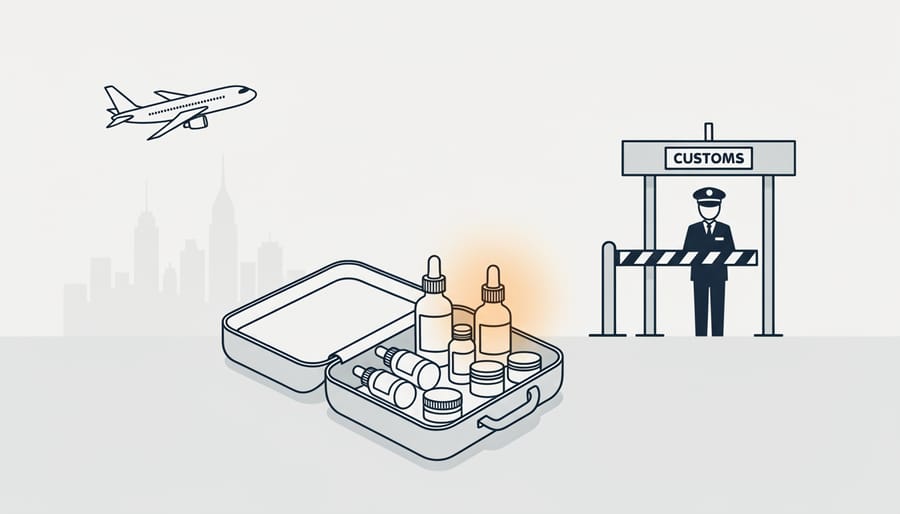
Canada’s border regulations make no exceptions for domestic cannabis legality. Taking any cannabis product across the border, whether you’re entering or leaving Canada, is illegal under federal law. This prohibition covers all CBD items, including hemp-derived oils, edibles, extracts and topicals, regardless of their legal status inside the country.
Aviation personnel face particular scrutiny at border crossings. Crew members traveling internationally must understand that the CBD products they can legally purchase in Canadian retail stores become contraband the moment they attempt to cross an international boundary. This applies whether you’re departing for a layover in the United States or returning from overseas. Border officials do not differentiate between CBD products and other cannabis forms during inspections.
The same strict framework that governs duty-free rules for alcohol and tobacco applies to cannabis, but with an absolute prohibition rather than quantity limits. Unlike some consumer goods that qualify for duty-free allowances, cannabis carries no permissible threshold. Pilots and cabin crew sometimes conflate consumer cannabis legalization with international travel permissions, but these remain entirely separate regulatory domains.
A narrow exemption exists for prescription drugs containing cannabis. Market-approved medications such as Epidiolex and Sativex fall under a travel class exemption that permits cross-border transport. These prescription products require proper documentation and medical authorization. Over-the-counter CBD supplements, wellness products and hemp-derived extracts do not qualify for this exemption, even when marketed as non-intoxicating or therapeutic.
For crew members managing travel anxiety or other conditions, the message is straightforward: leave all CBD products at home when crossing borders. The domestic legal status offers no protection in international travel contexts.
Practical Applications for the Aviation Workforce
Aviation professionals encounter hemp-derived CBD in everyday contexts, store shelves stocked with wellness gummies, online ads for pain-relief creams, colleagues who swear by CBD oil for sleep. The marketing message is consistent: these products are legal, natural, and safe. For pilots, air traffic controllers, flight service specialists, and cabin crew, that narrative collides with a stricter reality.
Transport Canada’s fitness-for-duty requirement doesn’t distinguish between marijuana-derived and hemp-derived cannabis. A pilot who uses a CBD topical balm for sore muscles after a long rotation faces the same 28-day prohibition before returning to duty as one who consumed a THC edible. The source of the cannabinoid is irrelevant; what matters is that the product falls under the cannabis umbrella. This means an over-the-counter CBD supplement purchased legally in a pharmacy triggers the same compliance obligation as a recreational cannabis product from a licensed retailer.
The gap between consumer perception and regulatory treatment creates practical risk. A flight controller might assume a low-dose CBD capsule marketed for stress relief is permissible because it contains no intoxicating THC, only to discover later that Transport Canada’s policy makes no such distinction. Similarly, cabin crew using CBD-infused skin lotion may believe topical application bypasses the prohibition, but the regulation focuses on cannabis use broadly, not route of administration.
For aviation personnel holding Transport Canada Medical Certificates, the compliance path is clear: avoid all cannabis products, including hemp-derived CBD, for at least 28 days before duty. Air operators may enforce stricter timelines, and no product marketing claim, whether “THC-free,” “non-psychoactive,” or “hemp-derived”, changes the regulatory standard. The safeguard is simple: if a product contains cannabis or cannabinoids, it’s incompatible with active flight duties under current Canadian aviation rules.
Common Questions About CBD in Canadian Aviation
Can I use CBD products if I hold a Transport Canada Medical Certificate?
No. Transport Canada’s June 3, 2019 policy requires all flight crew and flight controllers who hold Medical Certificates to avoid cannabis use, including hemp-derived CBD, for at least 28 days before duty, regardless of the product’s legal status or source.
Is it illegal to take CBD products across the Canadian border?
Yes. Canadian border regulations prohibit taking any cannabis across the border, whether entering or leaving Canada. This includes all products containing CBD, edibles, extracts, topicals, and oils, despite their domestic legal status.
Are there any exceptions for prescription CBD medications when traveling?
Yes. Prescription drugs like Epidiolex and Sativex, which contain cannabis derivatives, are permitted for cross-border travel under a travel class exemption. Over-the-counter CBD products do not qualify for this exemption.
Can my employer impose stricter cannabis rules than Transport Canada requires?
Absolutely. Transport Canada’s 28-day prohibition sets a minimum standard, but air operators have the authority to implement more stringent policies for their employees, including longer abstinence periods or outright bans on CBD use.
Aviation personnel often ask whether the 28-day rule applies to all cannabis products equally. The answer is straightforward: Transport Canada makes no distinction between THC-dominant products, balanced formulations, or CBD isolates. The fitness-for-duty requirement in the Canadian Aviation Regulations applies to any drug that impairs faculties, and the policy treats all cannabis derivatives uniformly.
Another common question concerns what you can carry when traveling internationally as a crew member. The blanket prohibition on cross-border cannabis transport means that even if you are not personally using CBD, you cannot transport it in checked baggage, carry-on luggage, or as part of a layover kit. This applies whether you are traveling for work or personal reasons.
Flight attendants and cabin crew sometimes wonder if they fall under the same rules as pilots. The answer depends on whether their role requires a Transport Canada Medical Certificate. Those who do not require certification are not subject to the mandatory 28-day policy, but they remain bound by the general fitness-for-duty standard and by any employer-specific policies their airline enforces.
Hemp-derived CBD occupies a legally distinct space in consumer markets, but Canadian aviation regulations draw no such distinction. Transport Canada treats all CBD products, regardless of source, as cannabis under the fitness-for-duty framework that governs flight safety. The 28-day prohibition established June 3, 2019 applies to every flight crew member and controller requiring a Transport Canada Medical Certificate, with no exemption for products marketed as hemp-derived or non-intoxicating. This regulatory stance prioritizes consistent safety standards over the nuanced categorizations that exist in retail cannabis law.
Aviation professionals face clear compliance obligations: avoid all cannabis products for at least 28 days before duty, recognize that employers may impose stricter rules, and understand that transporting any CBD product across Canadian borders remains illegal. The fact that a product is legal to purchase domestically does not make it permissible for aviation personnel or cross-border travel. As of 2026, the regulatory landscape continues to treat CBD strictly within the cannabis framework, reflecting Transport Canada’s commitment to maintaining impairment-free operations. For anyone working in Canadian aviation, the guidance is unambiguous, product marketing claims do not override fitness-for-duty requirements.